You can contact our president, Katie, at katie@searchdogs.org . Our other email address has been temporarily interrupted. Our contact phone number (for agency use) remains 979-217-1355.
Thank you!
You can contact our president, Katie, at katie@searchdogs.org . Our other email address has been temporarily interrupted. Our contact phone number (for agency use) remains 979-217-1355.
Thank you!
Law enforcement and search partners: We have updated our emergency contact number. Effective immediately, our contact number is 979-217-1355.
Others: If you are confronted with a situation involving a lost or missing person you should CONTACT LAW ENFORCEMENT IMMEDIATELY.
The sooner a search is started, the better the chance is of the missing person surviving being lost. Search Dog Network will only respond to calls from Law Enforcement or agencies having jurisdiction. With approval from the responsible agency, Search Dog Network will assist other organizations.
Law Enforcement: Since our team consists of Professional Volunteers, prompt notice is essential. Our Volunteers may need to take time off of work pick up our Canine Partners and get on the road to your location.
Thank you to our wonderful donors who contributed to our team through Brazos Valley Gives. Special thanks to Denise Fries, with Fries Financial Services in Bryan, Texas, who provided matching funds for us and two other local organizations during the event.
Search Dog Network is among the many organizations participating in the sixth year of “Brazos Valley Gives,” an opportunity to raise money and awareness for nonprofit organizations in our seven-county region.
Early giving for this year has started, and the “day” of the event is Tuesday, October 15th. Below is a 20-second promotional video that the team made for this event. We are very thankful for your support, and your sharing the video is appreciated! -Team Koda, Team Seamus, and Team Rocky
Over June 7th and 8th, 2024, several of our teams were (re-)certified by an IPWDA evaluator. These certifications are good for a two-year period. Congratulations to the following teams:
Wilderness Live Find:
Human Remains Detection:
Human Remains Detection – Water:
Dr Kim Stewart was recently interviewed for the Speaking of Pets podcast. We hope you enjoy watching!
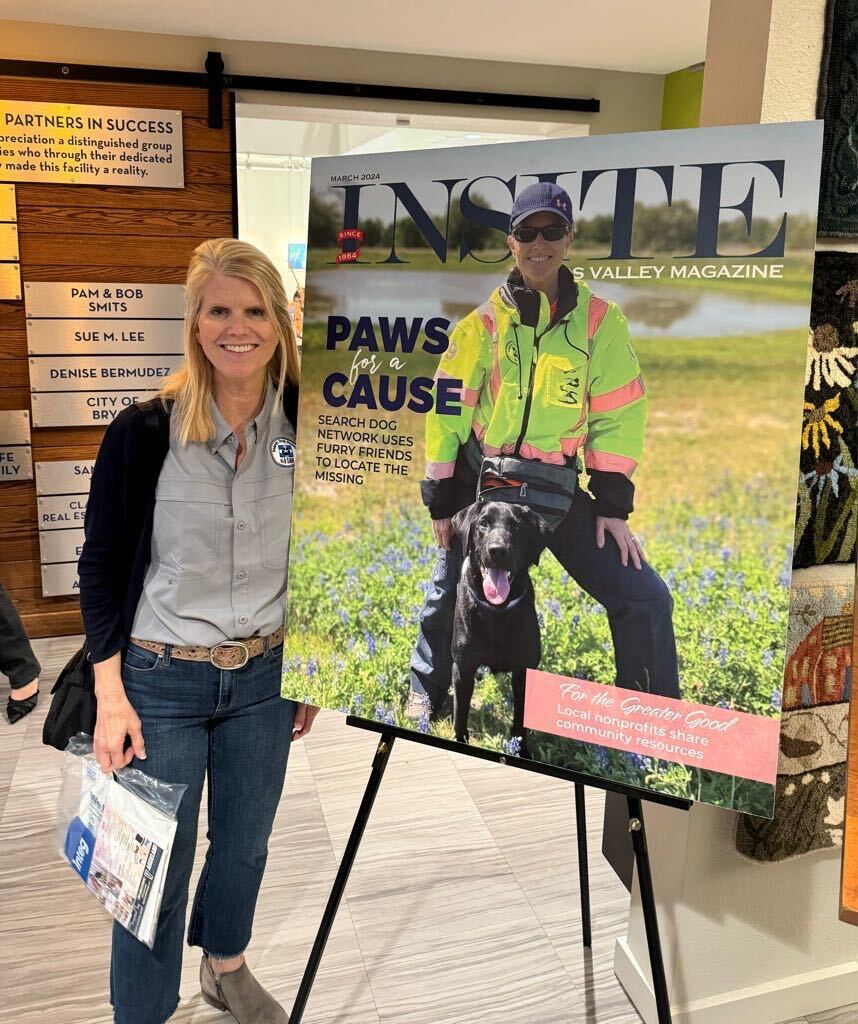
Thank you to Insite Brazos Valley for their write-up about Search Dog Network in the upcoming issue.
This month we want to highlight service dogs – to explain what the are, and what they are not, and briefly cover laws addressing rights and responsibilities of the person and the service animal.
A service dog (or miniature horse!) has been trained to assist a disabled individual. This could be a physical disability; visual, speech, or hearing impairment; mental disability; post-traumatic stress disorder (PTSD); developmental or intellectual disability. The tasks or work the animal is trained to do must be directly related to the disability. Texas law does not consider emotional support dogs to qualify, as they are not specially trained. An example of a task might be retrieving medication and/or water if the person is unable to do it because of a medical condition, or alerting about low blood pressure.
Under Texas law, service animals are legally permitted to accompany their person to all public places, including restaurants, schools, hospitals, stores, theaters, government buildings, public transportation, and so on, even if pets are not allowed.
Under the Americans with Disabilities Act, business owners may ask individuals with service dogs only two questions regarding their service animal: Is the service dog required due to a disability, and what type of work is it trained to do? The ADA states you may not ask questions about the disability, or request any documentation or certification about the disability or the animal.
A service animal is permitted to live in housing even if other pets are not allowed. However, there are some responsibilities. Dogs must be under control with a harness or a leash and not aggressive, or else they may be asked to leave a business. There is no “registration” for a service animal.
A business, organization, or person that denies a disabled person with a service animal public access to a business may be charged with a misdemeanor, fined up to $300, and/or required to do 30 hours of community service. The penalties are the same for someone who falsely represents their animal as if it is a trained service animal when it is not.
Before petting any dog, always ask if it’s ok.
Occasionally, Search Dog Network will train with or receive a request for assistance from the Amber Alert Network – Brazos Valley. The AAN-BV is a local resource, formed in 2003, that works with law enforcement, the local media, and the statewide Amber Alert Network in order to reduce the amount of time needed to respond to a report of an abducted child. AAN-BV can also assist with missing child and missing adult cases that do not qualify for an Amber Alert. (There are specific criteria that exist in order for an Amber Alert to be issued. More about that below.) The AAN-BV can work on publicity and organizing appropriate resources, while law enforcement focuses on the investigation.
“Our thought process is, even if it is not an Amber Alert, it is still imperative that that child… that they’re returned to where they’re supposed to be,” said Fleeger. “Because everybody matters.”
The AAN-BV also offers a program–the Brazos Valley Child Abduction Response Team (BVCART), formed in 2010–through which agencies in the seven-county Brazos Valley train together at least annually for better and faster response in the case of an abduction. Search Dog Network is a member of BVCART.
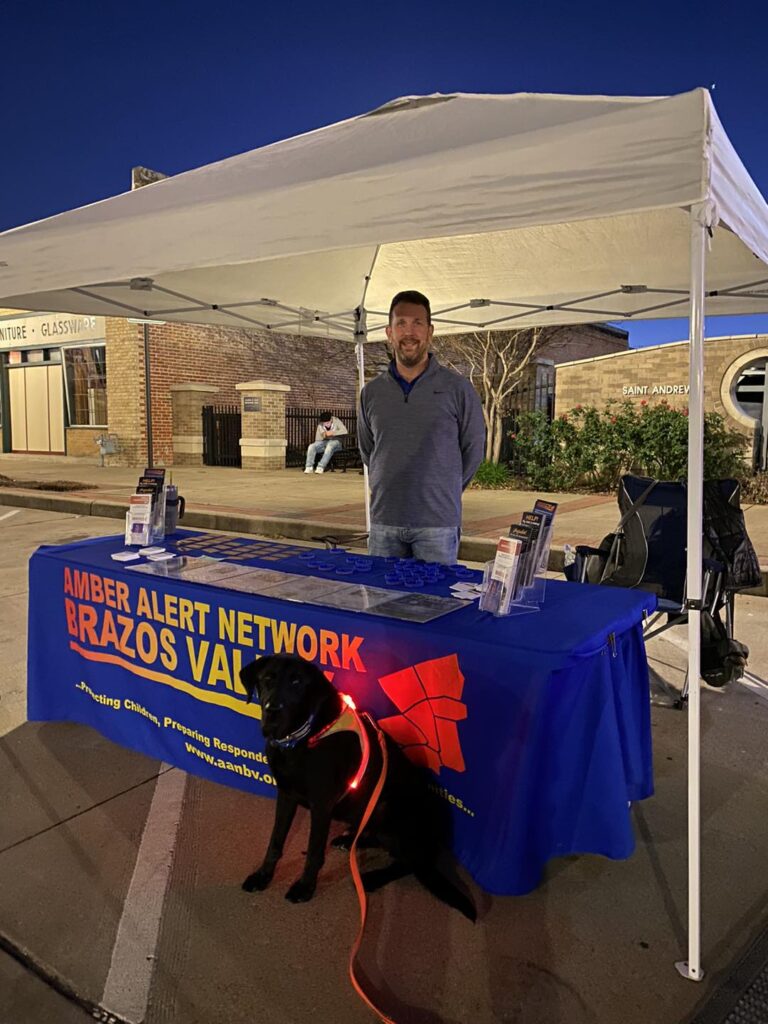
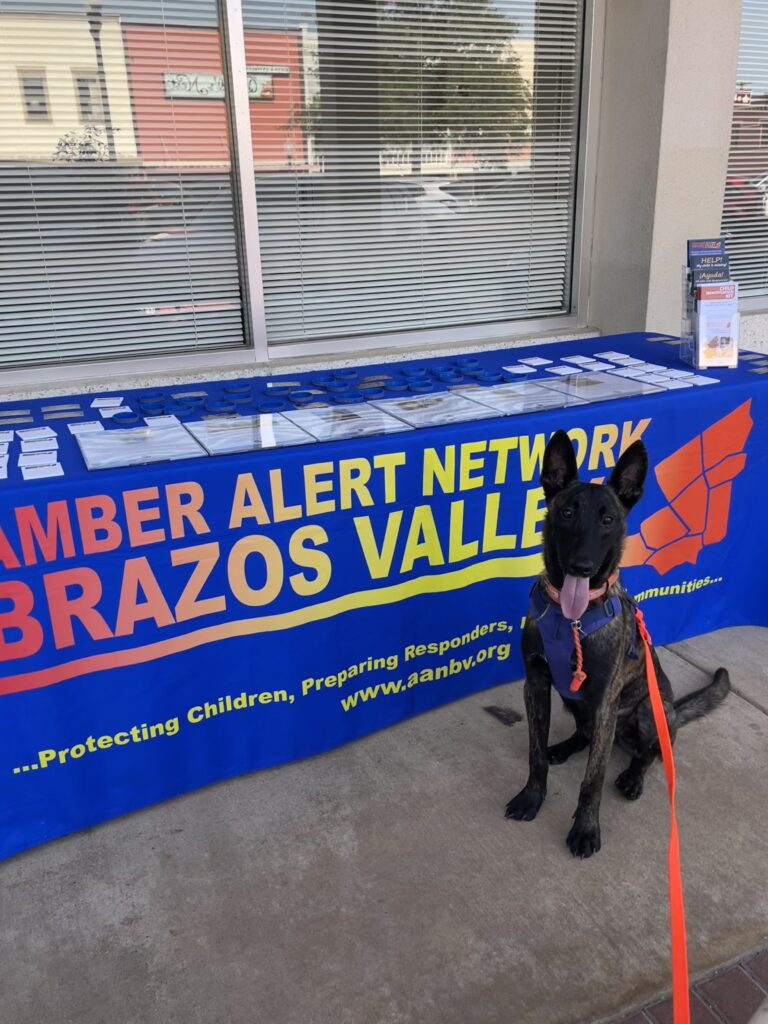
Chuck Fleeger, retired College Station PD assistant police chief and now Executive Director of the AAN-BV, is often at downtown Bryan’s First Friday event to raise awareness. You can usually find one or two SDN team members with him. Pictured left are Chuck and K9 Seamus; K9 Rue is in the photo below right.
Regarding Amber Alerts: according to this web site, following is a summary of the criteria that must be met in order to issue an Amber Alert:
You can read more details about the requirements at the linked website above.
The most important message we want to share is, if your child is missing, please know that there is NO WAITING PERIOD to report a child missing! Call 911! Here is a link to a list of other tips provided by the AAN-BV.
If you’re able to visit downtown Bryan for First Friday, stop by and say hello!
Are you traveling soon? Dr Kim Stewart, DVM, has given us permission to share an article previously posted on her clinic’s web page.
In case you are planning summer travel with your pets, here are some tips I hope will help.
Let us know if you plan to take your pet on a trip. We can ensure your pet has a clean bill of health. Your pet may need extra vaccinations or health certificates to travel, depending on your destination. Make sure you go over this with us. And while you are here, ensure your pet’s microchip (see point 2 below) is working.
If you have not gotten your pet microchipped and registered, get this done before your trip. It takes very little time to get done, and it is worth it to save you and your pet the heartache should your pet get away from you while you are traveling. Additionally, have your pet wear a collar and name tag with your cell phone number.
Before you leave town, check out your destination for emergency veterinarians to see if they will treat your pet during your travels if the need arises.
According to a AAA survey, over 80 percent of drivers admit that they recognize the dangers of driving with an unrestrained pet, but only 16 percent use pet restraints.
If a car crashes at just 25mph, an unrestrained dog can be projected forward at a force equal to 40 times its weight. A large-size dog weighing 75 lbs., for example, can achieve an impact force of 3,000 pounds in a car crash, which could be a lethal blow for both a passenger and the pet.
If traveling in a car, put your pet in a safety restraint or carrier secured to the seat with the seat belt. For example, dog restraints use the vehicle’s built-in lower anchor and tethers for children (LATCH) systems. These are found only in the second and third rows of cars. Cats need to be in a carrier placed on the back seat and secured with the seat belt.
Don’t travel with your pet in the front seat; they can be a distraction to your driving. Also, if an airbag deploys while your pet is in the passenger seat it could injure or kill.
It is extremely important to not leave your pet alone in the car, even for a brief pit stop. The temperature in a car can heat up rapidly. For example, on an 85-degree day, even with the windows opened, your car can reach 102 degrees in just 10 minutes. So, take your pet with you.
If you are driving and need to stop for food, you can visit drive-through restaurants and take your food to a park, or a rest stop where you and your pet can enjoy your meal together (keeping your pet on a leash of course). You can also search the web before your trip for pet-friendly restaurants.
We don’t want to see any of our pet parents suffer the heartbreak of losing their pet while on vacation. Even if your pet is well-behaved, keep them on a leash or harness if you take them out of the car. A leash can protect them from traffic and other animals.
Cats can be a bit trickier. Even if you don’t take your cat on walks with a harness and leash as a routine, it is best to train them to wear one if you travel with your cat. If harness and leash training isn’t possible, always keep your cat in the car until you reach your destination.
Plan frequent rest stops so your pet can get out of the car to exercise and eliminate. As mentioned above, if you have a cat, don’t let it out of the vehicle if it is not on a leash. You can give them breaks in the car to use the litter box, drink water, etc. as long as you leave the windows up and doors shut so they cannot escape. Make sure to bring a litter tray with disposable tray liners and litter.
Pets do best when kept on the same diet. Grocery stores along your route may not carry your pet’s brand. So, better to make sure you take enough food for your whole trip and take enough water. Also, don’t forget to pack food and water bowls.
If your dog or cat experiences motion sickness from the car, you can help them by taking steps ahead of the trip.
Start by taking short trips with your pet to get them used to travel. Use positive reinforcement to help them become less anxious about traveling in the car. You can even break it down to as easy as bringing them into the car, turning on the engine, and then getting them out of it and giving them a treat until you can build up to short trips. Familiarity with travel may help prevent car sickness.
There is also anti-nausea medication for pets. For example, Cerenia® is a veterinary nausea medication for pets. If you think your pet may need anti-nausea medicines, ask us during your wellness visit before your trip.
You can never be too prepared. It is good to have a first aid kit, any medications they might need, and anything else you can think of that you might need in a pinch. Here is a list of items to help put together your emergency or first aid kit:
These ten travel tips will help you safely take your pet wherever you go. If you want to take a trip but leave your pet at home, we can help there too!
Pet Boarding in College Station, Texas
We offer a convenient solution by providing pet boarding in our safe, clean, and comfortable environment.
Our professional and friendly staff takes great care of our pet guests. We understand that each pet is unique, and we will make every effort to ensure that your pet is safe, happy, and healthy during his or her stay. We’ll treat your pet with compassion and care and provide individualized tender loving care until you return.
We hope that you and your pets have a great rest of summer.
Sincerely,
Dr. Kim Stewart
College Hills Veterinary Hospital